Nippon Express Co., Ltd. (President: Shinjiro Takezoe; hereinafter "Nippon Express"), a group company of NIPPON EXPRESS HOLDINGS, INC. (President: Satoshi Horikiri), concluded an agreement with Nikon Corporation (President and CEO: Yasuhiro Ohmura; hereinafter "Nikon") for the provision of air cargo transport services utilizing Sustainable Aviation Fuel (hereinafter "SAF"), the goal being to help reduce Nikon's Scope 3*1 CO2 emissions by utilizing the NX Group's "NX-GREEN SAF Program".
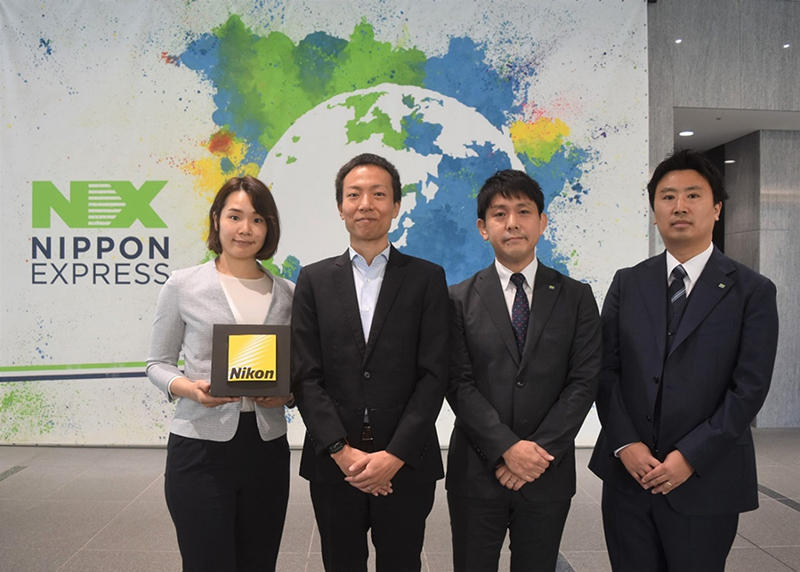
(Group photo of Nikon and Nippon Express representatives)
Nippon Express was selected for the second consecutive year as a designated cargo agent for the "Project to Promote SAF Use in Air Cargo Transport for Corporate Compliance with Scope 3 Requirements"*2 being implemented by the Tokyo Metropolitan Government, and it worked in that capacity to encourage the use of SAF. Nikon signed an SAF usage agreement with Nippon Express for the second consecutive year , extending its commitment first made in FY2024 to participate as a shipper in this project.
In keeping with its Long-Term Environmental Vision, Nikon contributes to building a sustainable society by balancing environmental responsibility with business growth. and the company is actively striving to reduce CO2 emissions across Scopes 1, 2, and 3.
As Nikon's long-standing logistics partner, the NX Group has provided extensive support to this end, primarily through international transport, and endeavored to resolve logistics challenges through sales and operational structures closely aligned with Nikon's needs. This collaborative partnership enables both companies to continue pursuing initiatives aimed at balancing environmental considerations with logistics quality.
Under this agreement, which covers air cargo shipments from May to December 2025, Nippon Express utilized the NX Group's "NX-GREEN SAF Program" to issue CO2 reduction certificates equivalent to the amount of Sustainable Aviation Fuel (SAF) used in air cargo shipments arranged by Nippon Express on Nikon's behalf, advancing Nikon's efforts to reduce its Scope 3 CO2 emissions. Nippon Express is thus assisting the multinational Nikon's environmental initiatives from the perspective of air cargo transport.
The NX Group has identified more robust responses to climate change as one of its materialities and established the following CO2 emission reduction targets for the group as a whole to achieve by 2030: a 50% reduction in Scope 1 and Scope 2 emissions from 2013 levels, and a 25% reduction in Scope 3 emissions from 2022 levels. The Group is also looking to help bring about a carbon-neutral society by 2050 (Scopes 1, 2, and 3). In June 2025, the NX Group's 2030 CO2 emission reduction targets were certified as SBT short-term targets*3.
Going forward, the Group will continue sharing its commitment to environmental conservation with stakeholders and carrying out initiatives that address materialities to realize its Sustainability Vision.
[Related press releases]
■NX Group begins offering "NX-GREEN SAF Program" in Japan
https://www.nipponexpress-holdings.com/en/press/2024/10-Apr-24-1.html
■Nippon Express signs agreement with Nikon for air cargo transport using SAF
https://www.nipponexpress-holdings.com/en/press/2025/27-Feb-25-1.html
■Nippon Express again selected in FY2025 as designated cargo agent for Tokyo Metropolitan Government project to promote SAF use
https://www.nipponexpress-holdings.com/en/press/2025/29-May-25-1.html
